 share
share
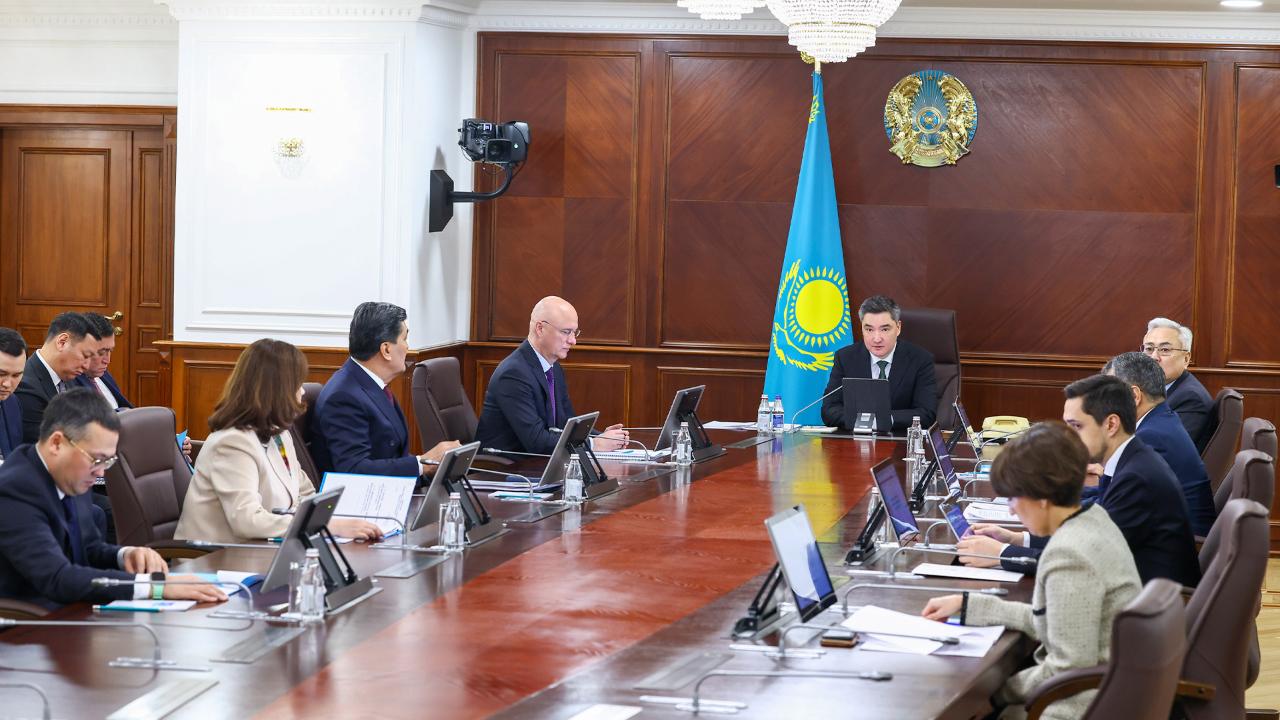
Prime Minister Olzhas Bektenov held a meeting of the Center for Monitoring the Implementation of the President’s Initiative “Taza Qazaqstan”.
The meeting addressed the use of digital technologies in environmental protection and the development of environmental culture among the population.
The Prime Minister emphasized the importance of enshrining the principles of a high level of environmental culture and a careful attitude toward nature in the draft of the new Constitution.
“I would like to especially emphasize that the promotion of responsible and creative patriotism, as well as the formation of a high environmental culture, are included among the fundamental principles of the draft of the new Constitution. This will foster a sustainable culture of cleanliness, respect for nature, and personal responsibility of every citizen,” Olzhas Bektenov noted.
According to the Ministry of Ecology and Natural Resources, within the framework of the presidential initiative “Taza Qazaqstan,” a total of 1,294 events have been held, 844 thousand tons of waste have been collected, 1 million hectares of territory have been cleaned, and 2.9 million trees have been planted. A total of 6.9 million people took part.
As part of the Year of Digitalization and Artificial Intelligence declared by the Head of State Kassym-Jomart Tokayev, special attention is being paid to the application of digital technologies in environmental protection. Minister of Ecology and Natural Resources Erlan Nysanbayev reported on the implementation of the National Environmental Data Bank project. The online platform aggregates indicators from a number of systems, including emissions monitoring, industrial environmental control, the pollutant release and transfer register, the state waste cadastre, the carbon cadastre, and others.
In the field of waste management, the EcoQolday digital platform is in operation. A forest fire early detection system is also being introduced, and the Tasqyn system, integrated with Kazhydromet data, is used to forecast flood situations. Work is underway to automate checkpoints at the most visited specially protected natural areas of Kazakhstan.
In the field of natural resources, the interactive map Tabigat.gov.kz has been implemented. First Vice Minister of Digital Development, Innovations and Aerospace Industry Rostislav Konyashkin reported that in 2025, space monitoring detected 3,828 unauthorized waste accumulation sites and more than 1,000 landfills.
The need for a comprehensive approach using artificial intelligence and available computing capacities was noted. The introduction of digital solutions will increase transparency, control, and the effectiveness of implementing the “Taza Qazaqstan” concept.
The meeting also reviewed the results of efforts to develop environmental culture among the population. Minister of Education Zhuldiz Suleimenova reported the launch of work on a Unified Environmental Education Standard for all levels—from schools to universities—with an emphasis on the values of “Taza Qazaqstan.” School and extracurricular formats are being developed in the regions, including the “Green Clubs” project and the “Zhasyl El” program.
Vice Minister of Science and Higher Education Gulzat Kobenova reported that environmental clubs and student eco-squads have been established in all universities, and bicycle days are being held. As part of the waste separation project, boxes and big bags have been installed in 26 universities, and more than 36 tons of plastic have been sent for recycling.
The role of information support for the presidential initiative “Taza Qazaqstan” was highlighted separately. Vice Minister of Culture and Information Kanat Iskakov reported that more than 1,000 events involving around 1 million young people were held in 2025. Together with public councils and non-governmental organizations, public monitoring is being carried out on issues of territorial cleanliness and the preservation of order at historical and cultural heritage sites.
The Prime Minister drew attention to the failure to achieve certain targets of the action plan under the “Taza Qazaqstan” Concept in a number of regions. In particular, insufficient work was noted in the Almaty Region on the introduction of irrigation systems and water-saving technologies, the provision of grants, and financing of non-governmental organizations. In the Ulytau Region, there is no inventory of green spaces, vending machines for recyclables (fandomats) have not been installed in places of mass gatherings, and digitalization of water supply and sanitation systems has not been carried out. In the Abai Region, planned indicators for the development of “green infrastructure” and the organization of environmental and cultural events have not been achieved. Akims of the Almaty Region Marat Sultangaziyev, Ulytau Region Dastan Ryspekov, and Abai Region Berik Uali reported on the work being carried out in these areas.
Following the meeting, the Prime Minister instructed regional administrations to ensure the implementation of all planned measures.
“The implementation of the ‘Taza Qazaqstan’ initiative has already yielded tangible results and clearly demonstrated a strong public demand for environmental transformation. Therefore, the task now is to move to the next level—building a systematic and manageable approach based on the use of modern digital tools, regular and objective monitoring, and a clear distribution of responsibility among all participants in the process. Such an approach will ensure the achievement of long-term results,” Olzhas Bektenov emphasized.
Instructions were also given to ministries to ensure the sustainable transmission of environmental data and access to computing resources, to expand the coverage and regularity of space monitoring, and to complete the scaling of the forest fire early detection system. The Ministry of Culture and Information was tasked with ensuring continuous information coverage of the “Taza Qazaqstan” concept.

 EcoQolday
 Check payment
 Login to the system
