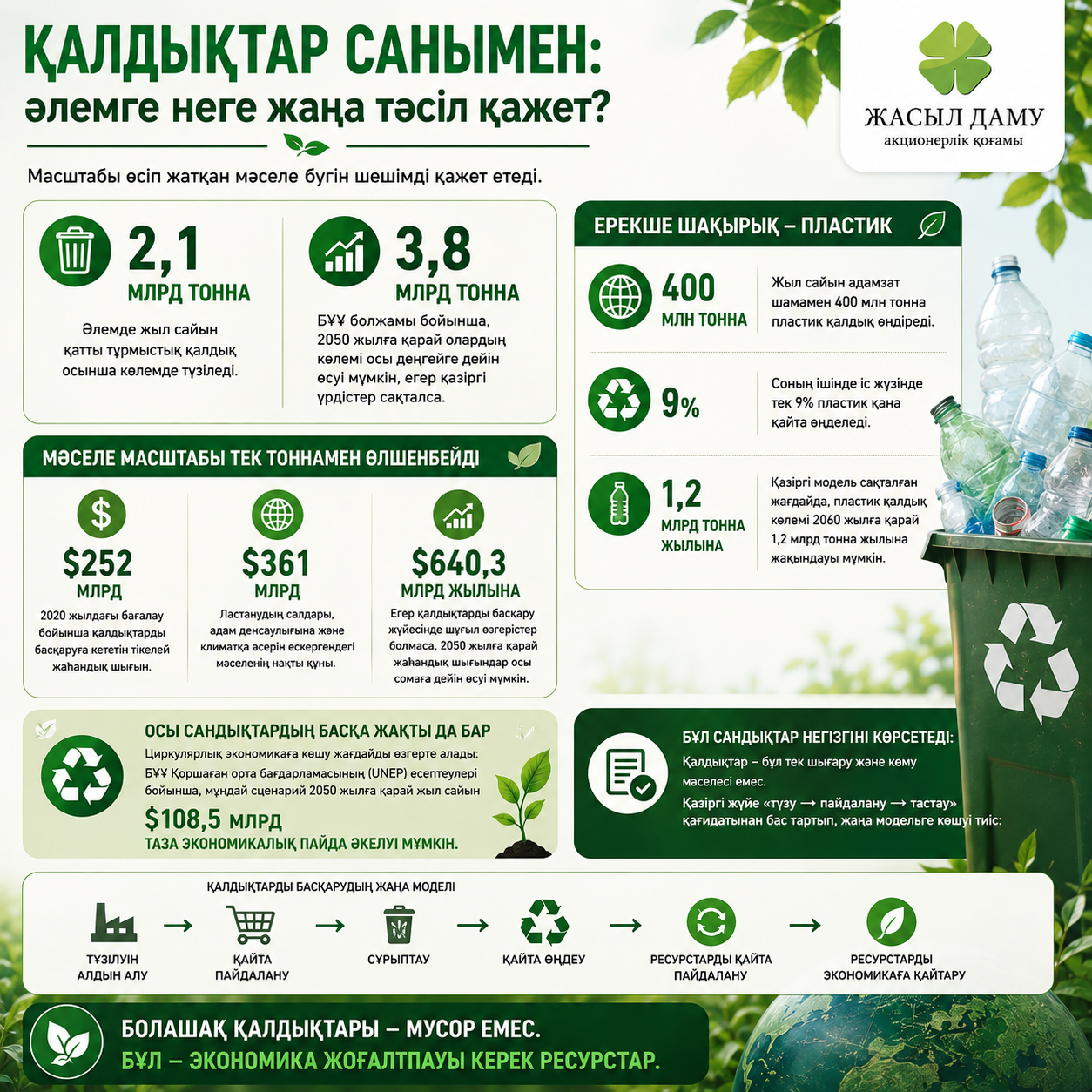
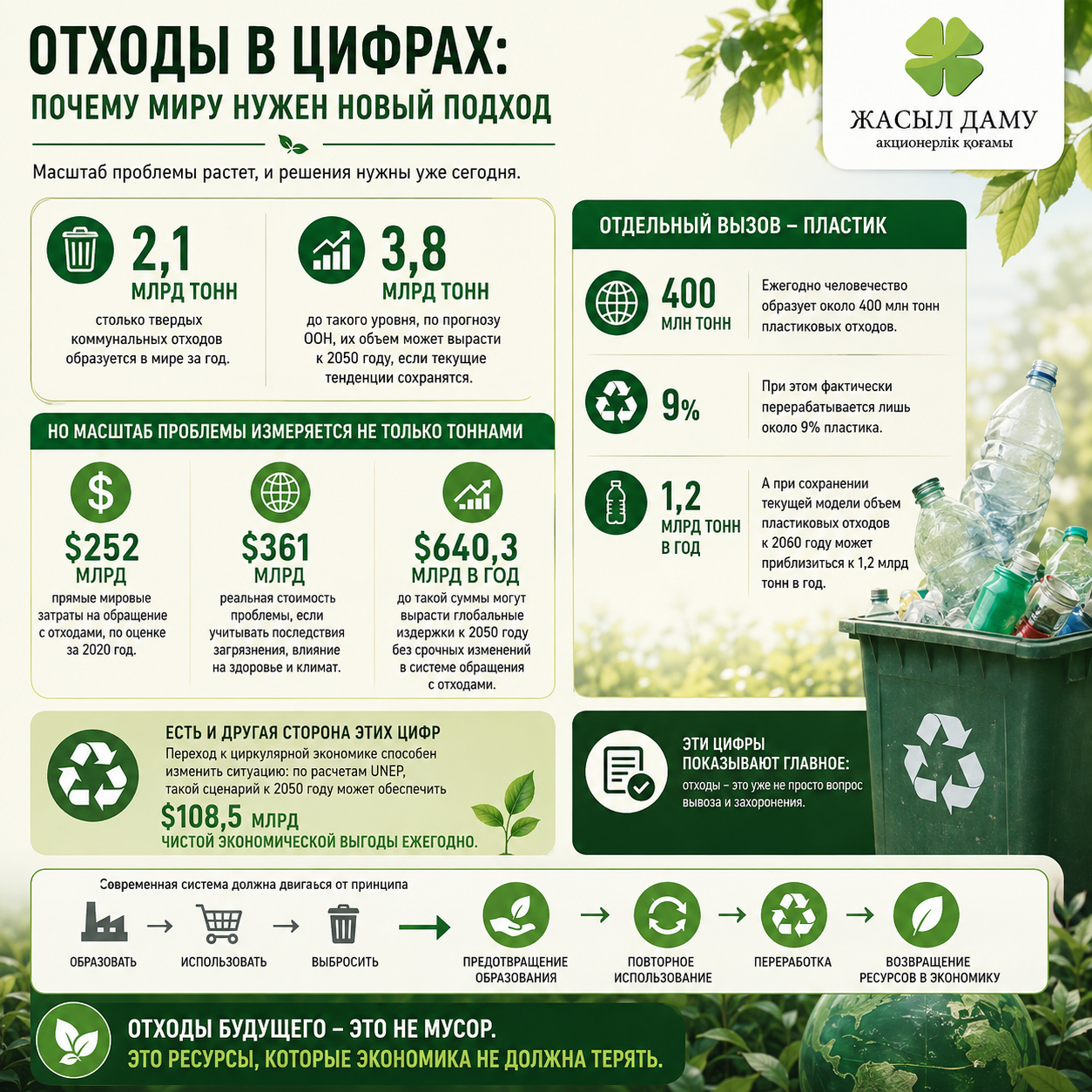
Every year, the world generates around 2.1 billion tonnes of municipal solid waste. If current trends continue, this figure could rise to 3.8 billion tonnes by 2050.
But the waste challenge is not only about volume. It also represents a significant economic and environmental burden.
In 2020, the direct global cost of waste management was estimated at approximately $252 billion. When the impacts of pollution, human health, and climate change are taken into account, the true cost rises to around $361 billion. Without systemic change, global waste-related costs could reach $640.3 billion annually by 2050.
At the same time, the transition to a circular economy creates new opportunities. According to UNEP estimates, more efficient use of resources, waste prevention, reuse, and recycling could generate a net economic benefit of around $108.5 billion per year by 2050.
Plastic waste deserves particular attention. Humanity generates around 400 million tonnes of plastic waste every year, while only about 9% is recycled. If the current model continues, annual plastic waste could approach 1.2 billion tonnes by 2060.
These figures make one thing clear: the modern waste management system must gradually shift away from the linear model of
“produce → use → dispose”
towards the principles of a circular economy:
waste prevention → reuse → recycling → returning resources to the economic cycle.
The waste of the future is not simply garbage. It is a resource that the economy cannot afford to lose.

 EcoQolday
 Check payment
 Login to the system

 share
share